
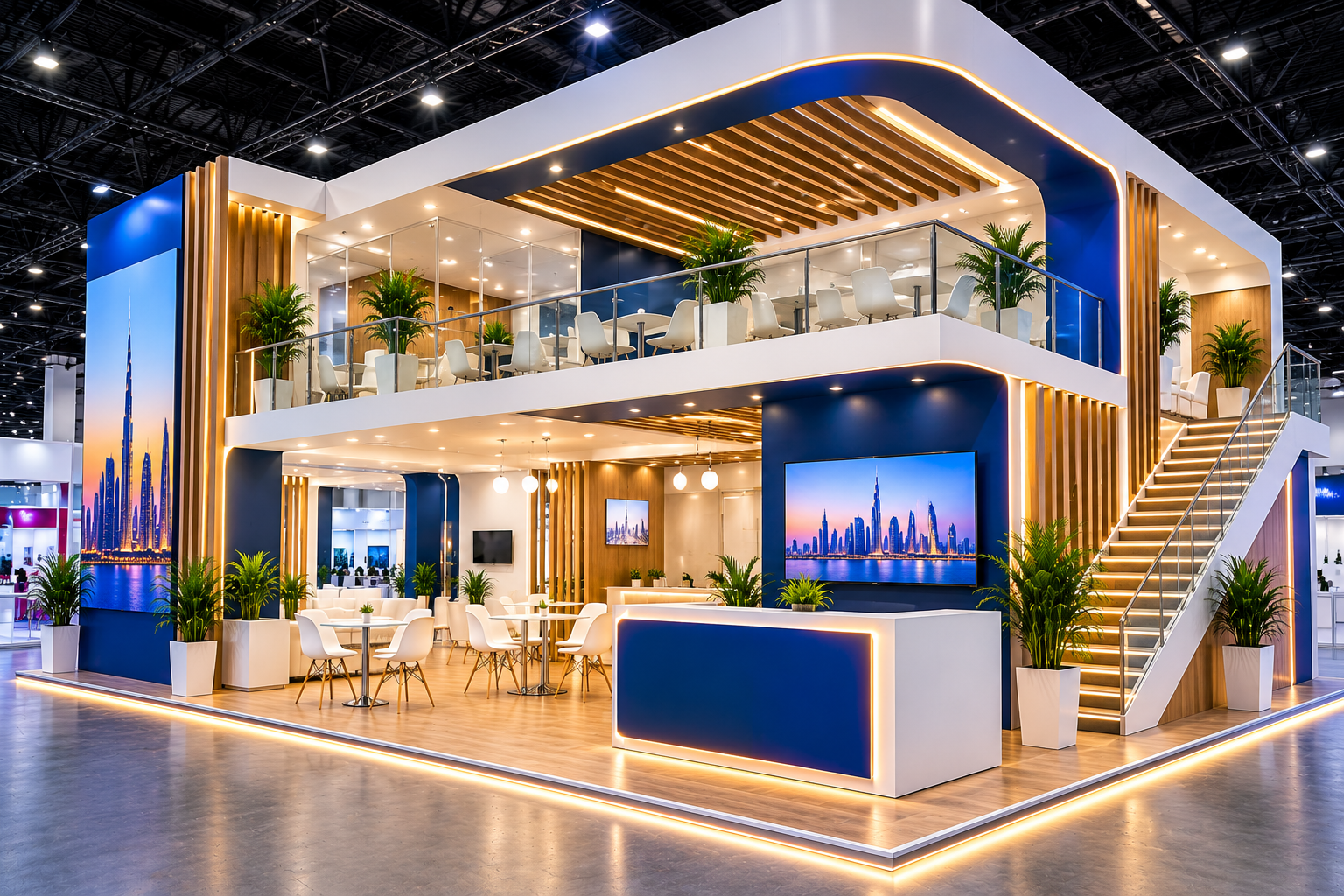

Floor space is the single largest line on most exhibition budgets in Dubai. At DWTC, ADNEC and Expo City, you pay per square metre before a single panel is built, which means the most expensive decision you make is how much floor you book. A double decker exhibition stand changes that equation. By building upward instead of outward, you get a second usable storey on the footprint you have already paid for.
Double decker exhibition stands are now a familiar sight at GITEX, Arab Health, Gulfood and Big 5. They are also widely misunderstood. Exhibitors assume they are reserved for the largest multinational budgets, or that the approval process is too complex to attempt. Neither is true, but a double decker exhibition stand does demand earlier planning and a contractor who has done it before.
Here are seven reasons exhibitors in the UAE choose two levels, and what you need to plan for if you do.
What Is a Double Decker Exhibition Stand?
A double decker exhibition stand, sometimes called a two-storey or mezzanine stand, is a purpose-engineered structure with a second floor built above the ground-level display. The upper deck is reached by an internal staircase and is typically used for meetings, hospitality or private demonstrations, while the ground floor stays open for visitor traffic.
Unlike a standard single-level build, a double decker exhibition stand is a load-bearing structure. It requires structural drawings, stamped engineering calculations and venue approval before anything is fabricated. That is the trade-off: more usable area, more process. The double decker exhibition stands in Dubai we build go through that approval chain as part of the scope, so the exhibitor is not managing it alone.
7 Reasons to Build a Double Decker Stand in Dubai
1. You Double Usable Area Without Paying for More Floor
This is the reason most exhibitors start the conversation. Organiser floor rental is charged on your ground footprint. A second storey built within that same footprint gives you additional usable area without increasing what you pay the organiser.
The economics are strongest when floor rates are high and availability is tight, which describes most major Dubai shows. If your alternative is booking a larger plot to fit a meeting room, building upward is usually the cheaper route to the same outcome. Our double decker ROI guide works through how that comparison plays out across a show cycle.
2. You Get Private Meeting Space That Actually Stays Private
Ground-floor meeting rooms on a busy stand are rarely private. Walls that enclose a room on a single-level build also block sightlines, reduce your open frontage and make the stand feel smaller. You end up choosing between visibility and confidentiality.
An upper deck removes that choice. Commercial conversations happen above the noise, physically separated from the show floor, while the ground level stays fully open. For sectors where pricing discussions and product roadmaps are sensitive, such as healthcare, defence, technology and energy, this alone can justify the structure.
3. Height Makes You Visible Across the Hall
Exhibition halls at DWTC and ADNEC are large, and visitors navigate them by landmark. A stand that rises above the surrounding builds is visible from the aisle three rows away and from the hall entrance. Branding carried on the upper fascia works at a distance that ground-level signage cannot reach.
This matters most when you are positioned away from main entrances or competing against larger neighbours. Height is a way of buying prominence that does not depend on plot location.
4. You Can Separate Visitor Flow From Business Conversations
A well-run stand serves two audiences at once: browsers who need to be attracted and qualified, and existing clients or serious prospects who need time and attention. On one level, these two groups interfere with each other. Demonstrations get interrupted, and meetings get overheard.
Splitting the stand vertically solves this cleanly. Product display, demonstrations and lead capture stay downstairs where footfall is. Scheduled meetings, hospitality and quiet conversations move upstairs. Your team stops competing for the same square metres.
5. Storage Stops Eating Your Display Space
Every exhibitor underestimates storage. Literature, giveaways, personal belongings, spare stock, packaging, catering supplies and AV cases all need somewhere to live for the duration of the show. On a single-level stand, that becomes a cupboard carved out of display area, or worse, boxes stacked visibly behind a counter.
A double decker exhibition stand absorbs this. Storage tucks under the staircase or into the structure itself, and the upper deck can carry back-of-house functions entirely. The ground floor stays presentable from every angle for all four days.
6. Hospitality Becomes Possible Without Sacrificing Display
Hospitality is how relationships get built at trade shows in the Gulf. Coffee, seating and a comfortable place to sit for twenty minutes do more for a serious prospect than any brochure. But a hospitality area on a single-level stand competes directly with your product display for space.
An upper deck gives you a lounge, a bar area or a seated client zone without surrendering ground-floor frontage. For exhibitors at shows like Gulfood or Arab Health, where meetings run back to back across the day, this turns the stand into a working space rather than just a display. You can see which shows suit this approach in our overview of trade shows and exhibitions in Dubai.
7. The Structure Can Be Reused Across Multiple Shows
A double decker exhibition stand is an engineered system, not a disposable build. Frames, decking, staircases and balustrades can be stored, reconfigured and rebuilt at a different size for the next show, with graphics reprinted to suit. Exhibitors running several events a year spread the structural cost across all of them rather than absorbing it once.
That changes how the investment should be judged. Compared against a single show, a double decker exhibition stand looks expensive. Compared against three or four shows with the same frame reused, the per-event figure often lands close to a custom single-level build.
What a Double Decker Stand Requires in Dubai
The structure of a double decker exhibition stand is only part of the job. Before fabrication begins, a double decker exhibition stand needs a documented approval chain.
Structural Drawings and Stamped Calculations
Venues require full structural drawings showing loads, spans, staircase geometry and balustrade detail, supported by calculations stamped by a qualified structural engineer. This is not optional and it is not something that can be produced on site.
Venue Submission and Deadlines
Drawings go to DWTC, ADNEC or the relevant organiser well ahead of build-up, and double deck submissions usually close earlier than standard stand designs. Missing the deadline can mean building single-level by default. Our guide to exhibition regulations and permits in Dubai covers the sequence in detail.
Fire and Safety Clearance
Civil Defence requirements cover exits, materials and permitted occupancy of the upper deck. Occupancy limits are real and enforced, so plan your upstairs capacity around what will be approved rather than what you hope for.
A Longer Build Programme
Approvals add weeks before fabrication starts, and the build itself takes longer on site. Start earlier than you would for a single-level stand. Our guide to how long an exhibition stand takes to build sets out a realistic timeline.
Is a Double Decker Right for Your Show?
Two levels are not always the answer. A double decker exhibition stand makes sense when your plot is large enough to carry a staircase without crowding the ground floor, when your ceiling height allows it, when you have a genuine need for private meeting or hospitality space, and when you have enough lead time for approvals.
It makes less sense on a small plot, at a show where your team is only two or three people, or when you have booked late and the submission window has closed. In those cases a well-designed single-level build, or an upgraded shell scheme booth rental, will serve you better than a compromised two-storey structure.
If you are weighing the options, it is worth understanding what drives the figures on both. Our breakdown of exhibition stand costs in Dubai explains what sits behind a quote, and our guide to choosing an exhibition stand builder in Dubai covers what to check before you brief anyone.
Frequently Asked Questions
How much does a double decker exhibition stand cost in Dubai?
Cost depends on footprint, structural complexity, finishes and how much of the upper deck is enclosed. The structure, engineering and approval work are the lines that separate a double deck from a single-level build. Ask for a quote that itemises structure, engineering fees, graphics, furniture, installation and storage separately so you can compare properly.
Do I need special permission to build a two-storey stand?
Yes. Venues require structural drawings and stamped engineering calculations submitted ahead of build-up, plus fire and safety clearance covering exits, materials and upper-deck occupancy. Your contractor should prepare and submit these as part of the scope.
How much space do I need for a double decker stand?
You need enough ground footprint to accommodate a staircase without obstructing visitor flow, and sufficient hall ceiling height for the upper deck plus headroom on both levels. Ceiling height limits vary by venue and hall, so confirm yours before committing to a design.
How long does a double decker exhibition stand take to build?
Longer than a single-level stand, because structural approval runs before fabrication rather than alongside it. The approval chain is usually the constraint, not the workshop, so begin the design process as early as your space is confirmed.
What should the upper deck be used for?
Most exhibitors use it for private meetings, client hospitality or confidential demonstrations, keeping the ground floor open for product display and visitor traffic. Some use it for back-of-house storage and team space instead, which frees the entire ground level for display.
Can a double decker exhibition stand be reused at another show?
Yes. The frame, decking and staircase are designed to be dismantled, stored and reconfigured. Graphics are reprinted to suit the next show while the structure stays, which is what brings the per-event cost down for regular exhibitors.
Are double decker exhibition stands only for large companies?
No. The deciding factors are plot size, ceiling height, lead time and whether you genuinely need separated meeting space, not company size. A mid-sized exhibitor with a real need for private client conversations often gets more from two levels than a large exhibitor who simply wants presence.
Planning a Two-Storey Stand for Your Next Show?
A double decker exhibition stand rewards early planning and penalises late decisions. If you have a show in mind, tell us your plot size, your hall and your build-up dates, and we will advise on whether two levels are viable, what the approval timeline looks like and what it will cost before you commit.
We design, engineer, fabricate and install exhibition stands in Dubai in-house, and we manage the structural submission and venue approvals as part of the build. Talk to our team to get started.